Tuesday, January 1, 2013

The Musical of Your Life


Everyone gets songs 'stuck' running through their heads.  But I've noticed something weird.  I will notice a song in my head, and realize I didn't just hear it, and may not have heard it for decades.  My subconscious just pulled it up because it 'associates' with something else going on here and now--something I'm doing, or watching, or reading....  My dang subconscious is playing DJ to my life!

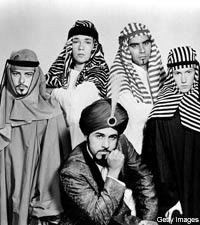
Right now, I have a song called "The Rhythm of Life" in my head.  (I expect instant recognition from just about no one.)  It's from the 1968 musical Sweet Charity.  It's not one of the hits from the show--those would be "Hey Big Spender" and "If They Could See Me Now."   Nah, this was a big long production number song that featured Sammy Davis Jr. and a crowd of 'hippies' (somebody's vision of hippies, had a lot of 'beatnik' in them).  Sammy is the 'guru,' laying a mystical and very rhythmic trip out for his adoring followers.  It really was a weird attempt by writers/performers who were never even into rock to try to catch a psychedelic wave.  Of course they missed.

But my brain dredged this thing up because I'm rereading Stranger in a Strange Land (for the first time in decades.)  That has the mock-religion racket called "The Fosterites" in it, very much a guru-leading-followers-around-by-nose thing.  Further, Stranger itself became a hippie culture cult object back in the day.  So, my subconscious DJ digs up Sammy Davis Jr. playing guru.  Crazy, man.


Saturday, April 28, 2012

Essay on Identity


Essay on Identity


“I yam what I yam.”  -- Popeye the Sailor


The words “identity crisis” entered my life shortly after Erikson launched the term into the culture in 1968.  That was the middle of my high school career, and I never learned an actual definition for the term—I just heard that an “identity crisis,” whatever it was, could be expected in young people like myself.  Mostly the term was used as slang—when someone showed any emotional or behavioral stress, someone else was likely to ask, “What are you doing—having an identity crisis?”  It is only just now, in research for this essay, that I’ve learned anything about what Erikson actually meant. 

It’s really been only recently—over the past couple of years—that I’ve started thinking in an explicit way about identity.  It started by observing some effects of identity in online discussion groups.  Online discussions take place as a series of typically short written messages, with conversations stretching over days or weeks.  A person posts a message, all participants can read it when they wish, and one or more may choose to reply.  People reply to the replies, and a sort of discussion happens.  What I noticed is that despite much earnest effort put into presenting rationales for beliefs and opinions, those who start with opposing opinions rarely change them.  Despite this, further messages that assert controversial points can be counted on to elicit counter-assertions, often from the same person who had laboriously made a similar case the last time the matter came up, and often directed at the same person who had disagreed with him on the previous occasion.  In case there is any doubt, of course I was one of the people in which I observed this behavior.  Reflecting on this repeated pattern, I started wondering  “Why are people generally impervious to each other’s logic on these issues?” 

Meanwhile, I happened to hear a documentary segment on NPR that seemed to bear on this matter.  The story involved a journalist who took on a project to investigate the “Vincent Foster Phenomena.”  His subject encompassed both the events surrounding Foster’s death, and the ‘subculture’ of conspiracy believers for whom sharing information and theories about this and other incidents had become a major avocation.  What interested me most was the reporter’s ultimate decision about the results of his investigation.  His evaluation of the evidence convinced him that there was indeed something “fishy” about the Vincent Foster “suicide.”  While he didn’t have definite evidence of what actually happened, he had good reason to believe that Vincent Foster did not commit suicide in the park where he was found.  But he further decided that “it didn’t matter.”  And he frankly admitted that he decided to think “it didn’t matter” because he was a mainstream reporter, not a “conspiracy believer.”   In other words, the reporter made a major decision on what was “news” based on a personal identity issue.

This example shows the enormous role identity plays in regulating social life.  In this specific instance a reporter had what would seem, objectively, to be a major story and a major moral issue: open questions suggesting the possible murder of the President’s Counsel.  But he consciously decided “it didn’t matter” because he believed he could not continue to be a ‘mainstream reporter’ if he pursued it.  And he was probably correct in so thinking: his peer group had already reached a consensus that this matter was “closed,” and further that it should remain so.  Had he attempted to push the story forward, he would have encountered social and career sanctions.   He would have been forced into a new identity, perhaps “maverick reporter,” an identity with tenuous support and privileges compared to his current status.  Individual identity is socially conditioned; to a large extent others have power to decide if our identity will be considered valid.  This gives social groups tremendous power to enforce conformity by considering certain beliefs and behavior symbolic of group affiliation.  If such affiliation is important to an individual’s identity, he is extremely unlikely to dissent from the group-mandated positions.  Thus the behavior of large groups is controlled by the group consensus on symbolic issues.

I think this social control aspect of personal/group identity has extremely important implications.  There certainly was no examination of such dynamics in the Political Science field in which I earned my BA degree, although in my undergraduate days the discipline was largely preoccupied with conspicuously unsuccessful attempts to understand the genesis and exercise of  “community power.”  There is much to know about how some issues take on symbolic importance while others do not, and how the “group line” on such issues is established.

This discussion of individual/group identity sheds some light on my question of why online discussions follow the pattern I described earlier.  People are defending issue positions because they are symbolic of group affiliation and self-identity.  They often continue to defend them even in the face of logic and evidence, since to change them would necessitate a change in self-identity, and people are highly averse to such changes.  Typically, people who are overmatched in debate stop participating in the discussions; seldom is a major shift in position seen online.   People would much rather fight than switch, and flight is likewise preferable.

I found a very interesting discussion of many identity issues in the paper “On Becoming a Person” by John Barresi of Dalhousie University in Nova Scotia (copy enclosed).  Out of a great many concepts and issues presented, there are two that I found particularly illuminating. 

One of the crucial areas of “personology” studies identified by Barresi is the “Narrative Creation of Persons” that begins in the adolescent years.  At this time people begin to consciously create “stories” of their own life, which constitute self-identity.  I thought Barresi made a very important point in passing when he noted that verbal language skills might play a crucial role in this process.  It seems obvious that construction of a narrative story is going to be hampered if one has problems expressing oneself with words.  This problem, alas, appears to be on the upswing with adolescents.  I recall a striking anecdote I heard, regarding a small group of young men observed ‘hanging out’ at a mall.  An especially attractive female passed by, and the young men were highly stimulated.  They all wanted to express their feelings verbally.  However, all that came out was the descriptive “awesome!”  They struggled and stuttered, seeking to find words adequate to describe their energized elevated state and the wondrous vision that had prompted it.  But “ah-ah-ah-awesome” remained the only utterance that escaped.  Any further speech powers had deserted them.  (This naturally must be a result of too much TV watching and video game playing).

Of course, one anecdote describing inarticulate teenagers does not define a trend.  Undoubtedly many teenagers are beautifully articulate.  But to the extent that such verbal disability exists, I think it’s a problem for the individuals and others.  If one cannot easily and flexibly create a narrative of self, one is all the more dependent on ready-made narratives offered by others.  Such a person is vulnerable to manipulation.  They can become ‘stuck’ in identity patterns that are working poorly for them, since they lack facility in creating ‘adjustments’ to their self-narrative.  Experiencing continued unsatisfactory life outcomes, and lacking the ability to adapt and change, they may become extremely frustrated and angry, and prone to destructive acts.

The whole matter of the influence of others on our self-narratives is a second point of Barresi’s that I found illuminating and provocative.  The social aspects of identity have manifold implications, but an especially valuable insight to me was the fact that personal identity, to be effective and successful, must be congruent with identity models and roles offered in the culture.  Otherwise, one does not receive cultural validation of one’s identity, and the friendship and cooperation of others is withheld. Barresi points out that the culture offers different identities to various classes of people.  I have always resented statements about the ‘privileged’ status of white males, but this discussion finally made clear to me at least one mechanism by which such privileging (or conversely, oppression) is accomplished.  Individuals, acting in accordance with social norms internalized into their self-identities, offer friendship, trust, cooperation, aid, encouragement, consolation, love, and all other interpersonal and social benefits.  Or, in other cases, they withhold such benefits and behave adversely.  Those favored are distinguished by being regarded as ‘respectable;’ those rejected are in effect and sometimes explicitly denied personhood.   Thus, insult and disrespect are a denial of the very humanity of the target.

Ironically, the investigation of identity issues leads me to two paradoxical attitudes.  On the one hand, I am gaining an appreciation of a personal and interpersonal process of vast significance.  The influence of identity narratives is enormous, and it is amazing to me that understanding of these issues is so poorly developed in the general culture.  On the other hand, with the realization that personal identity is largely extrinsic, largely plastic, and largely contingent, its power becomes to me highly questionable.  The ferocity with which most people defend their personal and cultural identity seems unwarranted.  It appears clear that if we ask “What should our identity be,” the answer will have to come, as Barresi observes, from outside the sphere of identity analysis.

Some 30 years after Erikson gave the world the concept of the identity crisis, the term is commonly used in a superficial way to mean ‘being in a state in which basic questions of function or goal are open.’  Companies, television shows,  and even whole countries are spoken of as undergoing ‘identity crises.’  Few indeed seem to have any idea what is at stake in the initial adolescent identity crisis—the often protracted period that begins when a person first becomes capable of creating a narrative elaborating an abstract concept of the self persisting through time.  The term ‘crisis’ is misleading in that most people think of a crisis as a relatively brief period in which emergency action must be taken to avert disaster.  The identity crisis can go on for years.  It ends with commitment—hopefully a strong conscious choice, sometimes a mere acceptance of the seemingly inevitable.  One way or another most of us eventually conclude, like Popeye, that who we are is settled and definite.  In a world full of others who desire to dictate changes to our self-narrative for their own benefit, we learn to defend our identities, filtering out messages from all but trusted sources.  But in fact we are what we become, and we always have the potential to make new choices.


Valparaiso, Indiana
August, 1999

Tuesday, December 8, 2009

No Sham Sam

"Uno, dos ... One, Two, Tres, Quatro!"

If you're of a certain age, that Tex-Mex countdown can get you ready. Credit producer Stan Kessler for having the savvy to press that bit of studio cut-up; credit Sam the Sham for creating and believing in Wooly Bully, one of the most energetic bits of fun ever to hit vinyl. He had to believe; another pro had taken pencil and paper and demonstrated that the odds against Wooly Bully going anywhere were 9000:1. Well it peaked at #2 on the Billboard chart, stayed in the top 100 18 weeks, sold about 3 million, was Billboard's 'Song of the Year' for 1965, and remains a much covered and merchandised classic. So much for estimates.

Mrs. DQ is the true Sam fan from back in the day. I always grooved on Wooly Bully, natch, but didn't know jack about Sam until I started webbing around a couple of days ago. But now I find, having read half a dozen interviews, and his bit of autobiography on his site, I'm sort of in love with the guy. Can't really explain it--guess we'll just have to call it 'insinuating charm,' maybe.

The real Wooly Bully was Sam's cat, so add 'cat person' to his list of credits. He also told one interviewer the Wooly Bully was his lemur--add that to his list of 'shams.' Also in the credits is his other #2 hit, Little Red Riding Hood, (a more-sly-than-it-seems exploration of the wolf's feelings), other more-forgettable novelties, and an album, Sam Hard and Heavy, that didn't sell at the time but is now a cult R&B classic. The album garnered him a 1971 Grammy--for the liner notes (it was Carole King's year). That award points up another of Sam's talents--he's inventive with words. Interviewers like him, he gives them good stuff (see lemur, above).

Sam went pretty far into the abyss in the 1970's--the musical career crumbled, and there were lots of drugs, and he pretty much lost it all. But he could have landed in prison, but didn't; and he could have died, but didn't, and when he climbed out of the hole, he gave the credit to God. He's still got religion, and the next few decades have been for gradually getting other stuff back. Someone showed up with his gold lamé stage jacket, stolen years before. Someone else returned the Gibson 355 he'd pawned. A Triumph motorcycle that had been his pride and joy came back a hulk, but he was able to restore it. He's always been getting back with the music. And over time there was healing with the family as well.

On his website recently, Sam identified himself as 'poet and motivational speaker.' The motivational speaking isn't the sort done for Rotary Clubs. Sam talks to the guys at prisons. Seems to have some cred.

The poetry is what you might call 'honest:'

Buying back the pieces of my life
That I lost along a journey filled with strife
All the gold one gains cannot repay,
Nor sooth the sorrow of those we hurt along the way


Sam's done his shammin.' Domingo Samudio is one real dude.


Some links:

1. Sam's Official Site: http://www.samthesham.com/
2. Salon interview/article by Steve Burgess: http://www.salon.com/people/rewind/1999/08/21/samsham/index.html
3. Go Memphis article by Bob Mehr: http://m.gomemphis.com/news/2009/Feb/06/samudio-sham-ing-no-more/
4. Discography page by Robert Kruse (read Sam Hard and Heavy liner notes here): http://www.robert-kruse.com/samudio/pages/albums.html

Friday, November 6, 2009

The Nazi Plan to Nuke Manhattan


1. Goering's Secret Plan

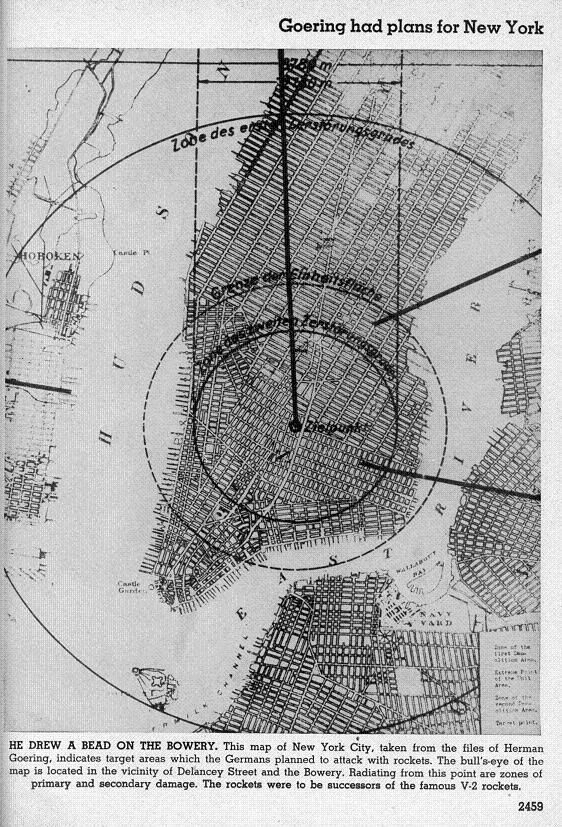
Before WWII ended, planners under Hermann Goering may have possessed accurate estimates of the effects of a nuclear weapon, and studied a nuclear attack on New York City. The diagram below is from a collection of thousands of World War II photos from news and government sources, collected and republished in book form in 1946.* The source, according to the caption added by the editors, is "the files of Hermann Goering." The caption makes no explicit reference to atomic weapons, but the proportions of the damage zones are suggestive to anyone who has seen more modern estimates of nuclear weapon effects.


*Source: Pictorial History of the Second World War: Volume V: A Year of Victory, Wm. H. Wise and Co, Inc, New York, 1946, p 2459. Photo Credit: "Press Association."

What appear to be translations of the German annotations are given in the lower right hand corner of the picture. These read, in outer to inner order:

1. Zone of the first Demolition Area
2. Extreme Point of the Unit Area
3. Zone of the second Demolition Area
4. Target Point

The existence of this diagram suggests that German nuclear weapons work may have been more advanced than is commonly understood. The accuracy of the data used to make this diagram can be judged by comparing it to this data on the blast pressure effects of a 20 kiloton weapon (a likely 1st generation yield, this was the approximate yield of the Nagasaki bomb.)


source: http://en.wikipedia.org/wiki/Effects_of_nuclear_explosions (table, "Summary of the Effects")

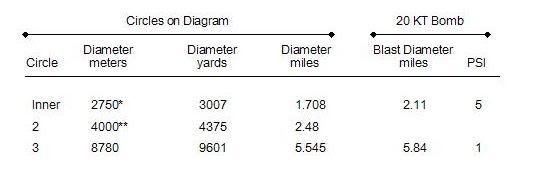
Overpressure of 2 psi would represent the outer limit of substantial destruction to brick buildings; in the 2-1 psi range windows would be blown out, people would be injured by flying glass, and other damage and some fires would occur, especially with wood frame structures. The Goering diagram includes diameter measurements, in meters, annotated near the top of the diagram. The following table gives these measurements, conversions to English units, and the corresponding blast data for the 20 kt bomb, with the later converted to blast diameter in miles:


* approximate; measurement partially obscured by mark on diagram 
** this measurement not given on diagram; estimated by measuring photo as published.

From this data it appears to me that this diagram is based on accurate estimates of the effects of a nuclear explosion with a yield approaching 20 kilotons. It therefore indicates that German atomic weapons research during WWII had advanced to the point that they possessed this data, and that they contemplated employing such a weapon against the United States.

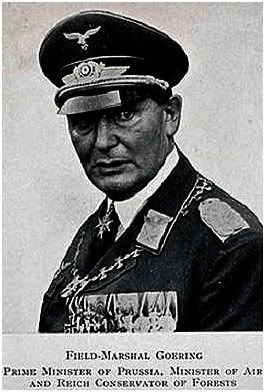
What is especially chilling is that this diagram is sourced not to some technical group, but to Hermann Goering. This is the only known direct evidence, to my knowledge, of Goering's knowledge at any level of nuclear weapons research. But awareness and interest in this area on the part of Goering, one of the very highest and most powerful political/military leaders in the Third Reich, could well have provided great impetus and resources to German efforts to develop and use an atomic weapon. This connection moves the threat of a German nuke on Manhattan from theory to a real historical possibility.

NOTE: The above analysis is a lay interpretation. Other interpretations are possible, such as that the attack contemplated would have been a barrage of missiles with conventional explosive warheads. In this case the circles might represent zones of varying likelihood of missile impact, given their inherent inaccuracy around the central aiming point. Also, the possibility that the diagram was created by an Allied source for propaganda purposes cannot be discounted. The question of the diagram's authenticity would have to be addressed by study of the original, and the evidence of its provenance.


2. The German Atomic Bomb Design

The following design is purported to be from a German report composed immediately after WWII, and summarizing the state of their atomic weapon research. It is a schematic, not a buildable design, but if authentic it is the only extant evidence of a German atomic bomb design from this period. The report's authenticity is controversial, there is no title page and its authorship is unknown. But taken together with the above target diagram, it may represent an atomic threat to the United States that was forestalled only by the timely conquest of Germany.


source: http://news.bbc.co.uk/2/hi/science/nature/4598955.stm

reference: Rainer Karlsch and Mark Walker, "New light on Hitler's bomb," physicsworld.com, June 1, 2005, http://physicsworld.com/cws/article/print/22270 (site requires free registration)

Wednesday, November 4, 2009

Carbon Farming: Diesel Exhaust Injection

There is a claim out that injecting tractor exhaust in to your field will mean you can skip all that expensive fertilizer, and save the planet too! It's absolute 100-proof junk science, but people want to believe it, and the 'one-born-every-minute' estimate will take in a certain number of farmers....

Here's the news item: http://www.theage.com.au/national/a-farmers-field-of-dreams-buries-climate-change-war-20091031-hqty.html

And if we can do arithmetic, and we can, here's an easily-testable quote from farmer Linklater: "It might not seem that emissions from one tractor could do a lot, but per hectare it emits 1100 kilos of carbon." Yes, he said 1100 kilos, and he said it more than once. And I'm here to tell you that Mr. Linklater's other claims (like you don't need fertilizer any more) don't make any more sense.

That 1100 kilo figure seemed bogus to me, so I did the math, with the help of a few data points from the Colorado State Agricultural Extension Service: http://www.ext.colostate.edu/PUBS/farmmgt/05006.html

1. A 100 hp diesel tractor uses 1.68 gal of diesel to plow an acre.

(Plowing, btw, uses much more fuel than most things that are done with tractors).

2. A 400 hp tractor, which Linklater has, won't use four times as much fuel, because it gets done faster, but let's say it does. So we're up to 6.72 gallons per acre.

3. There are 2.47 acres in a hectare, so that gives 16.6 gallons per hectare.

4. Diesel fuel weighs 7.0 lbs per gallon, so we're using 116.2 lbs/hectare.

5. And there are 2.47 lbs. per kilo, so we get to 47 kilos of fuel per hectare.

CONCLUSION: does anyone here think 47 kilos of fuel produce 1100 kilos of carbon emissions? The fuel is about 84.9% carbon, so if it all is 100% oxidized with two oxygen atoms for every carbon atom, you'd get (hmmm, atomic weight of carbon is 12.011, oxygen is 15.9994 ...) about 146.2 lbs of CO2.

But wait! I know what you're thinking! Maybe he meant over the course of the year, for all tractor use on the hectare. Let's see, 1100/146.2 means we're talking about passing over the field 7.5 times. But really you should figure 15 or more passes, because most things use half as much fuel as plowing, or less. And don't forget we are NOT really using four times as much fuel as a 100 hp tractor. I'll bet it would really take 30 or more passes....

Still, let's say he just might get to 1100 kilos per hectare if he captures every bit of tractor emmisions all year and injects it all. There's one other little problem with this scheme. Diesel exhaust won't fertilize. Not at all, no way.

From the data in the news story, it would seem that Linklater was applying something over 90 kilos of fertilizer per hectare. It is proposed to replace that with a substance which by weight contains:

1) 75.2% nitrogen, in the form of N2 passed through from the air, essentially inert stuff,
2) 15.0% oxygen, again from the atmosphere, what's left over from oxidizing the diesel fuel
3) 7.1% carbon dioxide, the main combustion product
4) 2.6% water vapor.

So that's 99.9% of the weight, and nothing that acts like a fertilizer yet (link, see Table 21). Oh, carbon dioxide encourages plant growth, if it's available to be absorbed in the leaves. But gaseous CO2 injected into the soil is going to do nothing but float right out of the soil, and not hang around. Though with some luck (bad) it will combine with water in the soil and makes carbonic acid and stuff. Soil acidification is not helpful. The conventional program of 90 kilos/hectare of fertilizer contained needed quantities of available nitrogen and phosphorus compounds; the 1/10th of 1% we haven't accounted for of whatever amount of exhaust is injected...does not.

It seems, though, that they were pushing this nonsense a couple of years ago in Canada. Here's an actual scientist pointing out that no matter how much exhaust is injected, this whole idea doesn't work anyway: http://www.minotdailynews.com/page/content.detail/id/514706.html?nav=5010&showlayout=0

Monday, November 2, 2009

All Hail Fred!

If Zionism isn't racism, it will do until racism comes along....

Now I don't know how much you can quote and still be in 'fair use' territory, but the quickest and by far the most effective way for me to tell you why I dearly love Fred Reed is to copy a chunk of what he says. This is from a column this summer on Zionism and Israel:


Although I am a Southerner, and like being one, I detested the apartheid practiced in the South. I was there. Don’t tell me ‘bout dem happy niggahs plunking dat ol banjo undah dee big oak tree. It was ugly. Jews, I note, didn’t like it either, and in fact led the movement for civil rights.
If I didn’t like brutal repression (which it was) engaged in by my own people, why am I supposed to like it when engaged in by Israelis? And why do Jews, who didn’t approve of it in the South, support it in Israel? Why don’t they tell Israel to stop it? They could.
Repressive custody of others does no make nice people. My family (the Venables) for two centuries lived in Prince Edward County, Virginia. In the early Fifties, as desegregation gained ground, we were the resistance, the Power Structure, the AIPAC of the region. Those with an idea of history may remember that Prince Edward shut down the public schools to avoid contact with blacks. The reasons given were many, some better than others, but ultimately the system was just wrong.
I spent a fair amount of time listening to my parents and relatives drinking bourbon in stately living rooms in Farmville, the county seat, and talking race. I know how their heads work. I know the grinding hatred, the contempt that dripped from every sentence, the herdishness as they confirmed each other’s snarling.
They sounded exactly like American Zionists speaking of Arabs. There was the same insistence on racial inferiority, on the filthiness of blacks or Arabs, their historical uselessness, their incapacity to fit into a civilized world, their sexual appetites. There is nothing Jewish in this. It is the normal moral sewerization that results from the relation of masters to slaves. Prison guards have it. South Africans had it. The only good Indian is a dead Indian. The underclass are always vermin, and the masters always become moral monsters. The Nazis, early Likudists, had identical notions of Jews.
I find myself wanting to say to AIPAC: What are you clowns thinking? How do you see the end game? You support a goose-stepping government in colonizing the West Bank to the point that it is irreversible. Then what? Your choices are extermination of your Arabs, ethnic cleansing on a horrific scale, or South Africanization. And how well did that work?
Because Jews have a well-earned reputation for being intelligent, one might make the mistake of expecting them necessarily to behave intelligently. No. Brains only provide the means to be more elaborately and ornately stupid. The smart merely make more complex mistakes. Historically, horrendous misjudgements have usually been the children of good minds. When you mix acuity with fanaticism, you get an ungodly stew almost certain to end in disaster. This may be worth thinking about.
http://www.fredoneverything.net/Fascisms.shtml


There. Wasn't that just right? And even when Fred happens, as even the best must, to be ever so slightly mistaken on some matter, he never fails to be amusing. Even his meanness is always, you can tell, done in a spirit of good clean fun. Or rotten dirty fun, which of course is the best kind.

Now I gotta run and make a deposit in the quote bank. "Brains only provide the means to be more elaborately and ornately stupid" is a keeper.

Sunday, November 1, 2009

Islam: Threat or Menace?

This clip of some upset fellows in England is said to illustrate the point:

http://www.youtube.com/watch?v=xuAAK032kCA

'Islam will conquer. Islam will destroy.' Yes, there are those who dream such dreams. There are even some who act accordingly. It's a problem.

Many of the actions taken to 'oppose' this problem have had the effect of making it bigger. I include 'invading Iraq' and 'torturing prisoners.' In dealing with this problem, it is vital to avoid stupidity.

Force often summons forth opposing force. Defining people as enemies makes more of them enemies. We (the West) must respond more intelligently, not be sucked into a mindless cycle of conflict.